

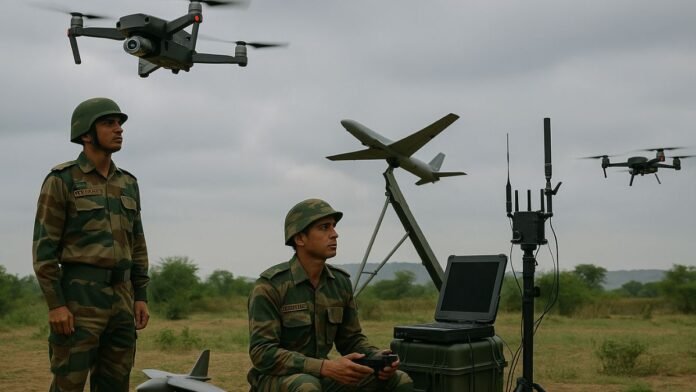
New Delhi: The Indian Army has placed orders worth over ₹5,000 crore for indigenous drones, following rigorous trials that simulated the challenging conditions of Operation Sindoor.
These trials recreated battlefield scenarios involving heavy jamming and spoofing, ensuring the selected systems can operate effectively in electronic warfare environments. Emergency procurement powers, granted post-Operation Sindoor, have enabled this swift acquisition process.

A three-tiered selection process was employed, beginning with meticulous inspections to exclude any Chinese-origin components, a critical measure for national security.
Drones then underwent intensive testing in a specialised electronic warfare area, where heavy jamming was applied from launch onwards to mimic real threats.
High-altitude operations formed the final tier, validating performance across diverse terrains like those along the Line of Actual Control.
Munitions India Limited, a public sector unit, surprisingly secured contracts worth nearly ₹500 crore for loitering munitions, marking its first major order in this category. In the private sector, NewSpace Research & Technologies partnered with SMPP Pvt Ltd to bag around ₹725 crore for surveillance and Kamikaze strike drones, positioning them as key players.

Other shortlisted firms include ideaForge for surveillance drones and JSW for vertical take-off and landing unmanned systems, with additional contracts nearing finalisation.
These procurements cover a spectrum of capabilities, from short-range kamikaze strikes to long-range precision munition delivery and reconnaissance.

Operation Sindoor highlighted the pivotal role of drones in modern warfare, with indigenous systems like those from Zuppa Geo Navigation proving resilient against jamming during surveillance missions. The focus on self-reliance aligns with broader ‘Aatmanirbhar Bharat’ goals, reducing import dependency amid rising global threats.
This influx of orders boosts India’s drone ecosystem, involving start-ups and established firms in high-altitude and contested environments. Companies like IG Drones and Solar Industries have prior successes with FPV Kamikaze and Nagastra-1 loitering munitions, further validated in post-Sindoor trials.
The move enhances tactical edge for the Army, particularly along borders, while spurring job creation and technological innovation in defence manufacturing.

