

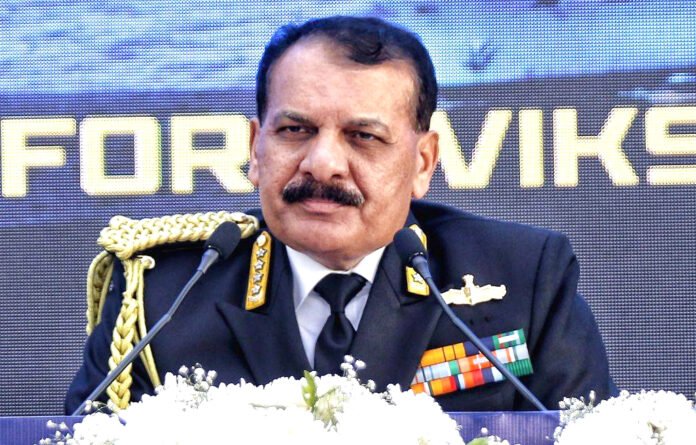
Two days before Russian President Vladimir Putin embarks on an official visit to India—his first to New Delhi ever since the Ukraine conflict broke out in February 2022—India’s Navy chief Admiral DK Tripathi has said that there is no ‘conflict’ in the Indian military having logistics agreements with both the US and Russian militaries.
The Navy chief’s statement acquires significance in the backdrop of the fact that India and Russia are expected to ink the Reciprocal Exchange of Logistics Agreement (RELOS) during the presidential visit for easier logistics access between the navies of the two countries

At the Navy’s annual press conference, the Navy Chief further detailed recent operations and future plans, highlighting heavy deployment at sea, anti-piracy, and anti-drug missions, along with upcoming assets such as Rafale fighter jets and new submarines. Admiral Dinesh K Tripathi shared these updates during the Navy Day press conference, stressing activity since the last Navy Day and cooperation with other national agencies.
Admiral Tripathi explained that sustained missions in the Gulf of Aden and nearby waters have continued without a break since 2008. According to Admiral Tripathi, warships, aircraft, and helicopters remain active across key sea lanes, with a sharp focus on piracy around the Red Sea, while parallel efforts target narcotics smuggling in the wider Indian Ocean region.
Admiral Tripathi explained that sustained missions in the Gulf of Aden and nearby waters have continued without a break since 2008. According to Admiral Tripathi, warships, aircraft, and helicopters remain active across key sea lanes, with a sharp focus on piracy around the Red Sea, while parallel efforts target narcotics smuggling in the wider Indian Ocean region
“Cumulatively, we have clocked almost 11,000 ship days and 50,000 flying hours since the last Navy Day and counting. We have maintained one ship in the Gulf of Aden continuously since 2008. The ship is relieved on station for anti-piracy duties. To date, 138 ships have been deployed for that, and they have successfully escorted more than 3,700 merchant vessels of all nationalities and crew. Since November 23, when the Red Sea crisis began, which led to an increase in piracy incidents, we have apprehended 62 pirates… Since November 23, due to heightened activity, especially by non-state actors like the Houthis, our 40 capital ships, along with their integral assets (helicopters, etc.) and capabilities, have been deployed,” he said.
These figures underline how wide the Indian Navy’s security role has become across busy trade routes. The focus on merchant vessel safety covers ships of many flags, while capital ships and aircraft increase presence where threats from pirates and non-state groups are reported.

Admiral Tripathi also described modernisation steps for the Indian Navy. He said the force is projected to receive the first batch of four Rafale fighter jets by 2029, adding that Project 75 India, which covers six advanced submarines, has reached an advanced stage, with a formal contract expected soon.
Admiral Tripathi also described modernisation steps for the Indian Navy. He said the force is projected to receive the first batch of four Rafale fighter jets by 2029, adding that Project 75 India, which covers six advanced submarines, has reached an advanced stage, with a formal contract expected soon
He further said India will soon commission its third indigenous nuclear-powered and ballistic missile-carrying submarine named ‘Aridaman’. This is India’s third ship submersible ballistic nuclear (SSBN) after INS Arihant and INS Arighat.

Speaking about combat readiness, Admiral Tripathi recalled the Indian Navy’s posture during Operation Sindoor against Pakistan. Apprising media about the Navy’s role during the Operation Sindoor, Admiral Tripathi said the aggressive stance and deployment of battle ships forced Pakistan to remain at their ports.
Admiral Tripathi then quoted how the carrier group’s movement limited Pakistan Navy activity. “The aggressive posturing and immediate action during Op Sindoor, of deployment of the carrier battle group forced the Pakistan Navy to remain close to their ports or near the Makran coast,” he said.
Admiral Tripathi linked this example with current deployments, saying visible presence and quick decisions are central to the Indian Navy’s approach in regional waters. Admiral Tripathi also highlighted the Navy’s role in anti-narcotic operations. “As far as the anti-narcotic operations are concerned, our units on deployment in concerned with other national agencies have seized contraband worth Rs 43,300 crores last year,” he said.
Speaking about combat readiness, Admiral Tripathi recalled the Indian Navy’s posture during Operation Sindoor against Pakistan. Apprising media about the Navy’s role during the Operation Sindoor, Admiral Tripathi said the aggressive stance and deployment of battle ships forced Pakistan to remain at their ports
On the occasion Admiral Tripathi also released the Indian Maritime Doctrine 2025.
Significance of the Naval Doctrine. The Indian Maritime Doctrine is the apex guidance document of the Indian Navy. Initially published in 2004 and revised in 2009, with minor amendments in 2015, the 2025 edition reflects the major transformations in India’s maritime environment and strategic outlook. The Indian Maritime Doctrine 2025 lays the foundation for the Navy’s strategy and operations, providing a shared understanding of the principles that guide employment across the spectrum of conflict. It clearly defines the Navy’s roles, answering the central question: “Why we do what we do.”
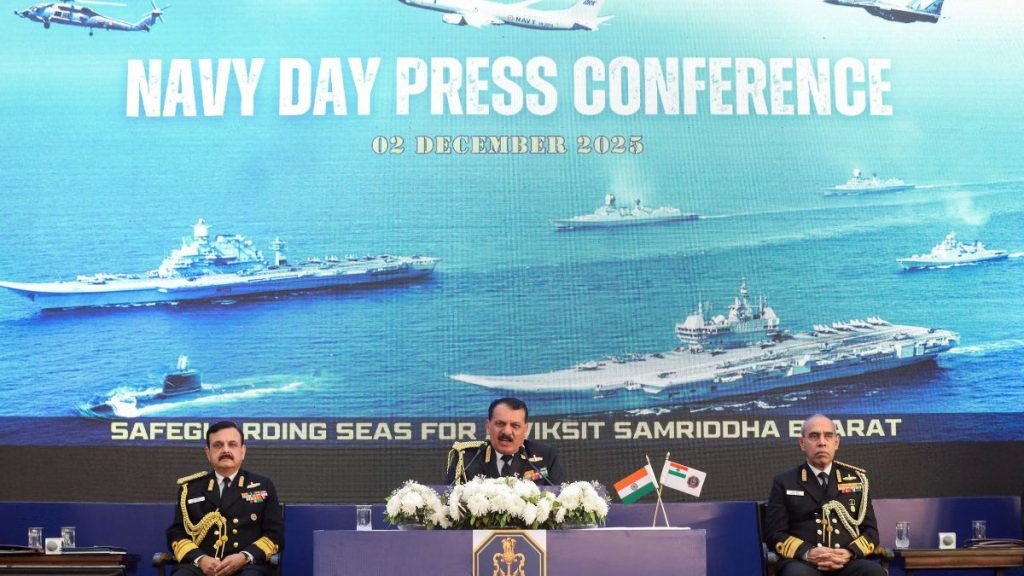
The 2025 edition reflects the transformation in India’s maritime environment over the last decade and incorporates India’s broader vision of harnessing the oceans as a key pillar of Viksit Bharat 2047. This outlook is reinforced through major Government of India initiatives, such as Sagarmala, PM Gati Shakti, Maritime India Vision 2030, Maritime Amrit Kaal Vision 2047, and MAHASAGAR. It also recognises the growing maritime security challenges characterised by multi-domain threats, a diverse set of actors, and rapid advancements in technology.
The Indian Maritime Doctrine 2025 lays the foundation for the Navy’s strategy and operations, providing a shared understanding of the principles that guide employment across the spectrum of conflict. It clearly defines the Navy’s roles, answering the central question: “Why we do what we do”
The latest edition also formalises ‘No-War No-Peace’ as a distinct category between peace and conflict, establishing it as an important facet of the conflict spectrum. It integrates an enhanced understanding of tactics employed by adversaries, including grey-zone, hybrid, and irregular warfare. The revised doctrine also acknowledges the growing importance of the space, cyber, and cognitive domains, while emphasising on the integration of uncrewed systems, autonomous platforms, and emerging technologies. Additionally, it prioritises jointmanship by aligning with tri-service joint doctrines, towards ensuring interoperability across the Armed Forces.
The Indian Maritime Doctrine 2025 is intended to advance India’s regional role and maritime influence while fostering a maritime-conscious nation that recognises the centrality of maritime power to national security. It seeks to strengthen jointness and integration across services and guide the translation of doctrine into strategy, operational directives, tactical publications, and naval capability development.
The Indian Maritime Doctrine 2025 is intended to advance India’s regional role and maritime influence while fostering a maritime-conscious nation that recognises the centrality of maritime power to national security. It seeks to strengthen jointness and integration across services and guide the translation of doctrine into strategy, operational directives, tactical publications, and naval capability development
The Indian Navy will mark Navy Day 2025 with a grand Operational Demonstration on December 4 at Shangumugham Beach in Thiruvananthapuram, Kerala.
Continuing its tradition of hosting Navy Day celebrations beyond major naval stations, the event follows similar commemorations held in Puri, Odisha, and Sindhudurg, Maharashtra, in recent years. The mega demonstration will offer citizens a rare opportunity to witness the Navy’s multi-domain operations and technological prowess up close.
According to the Navy, the event will showcase its state-of-the-art platforms and operational capabilities, reaffirming India’s position as the “Preferred Security Partner” in the Indian Ocean Region under the broader vision of MAHASAGAR (Mutual and Holistic Advancement for Security and Growth Across Regions).

