

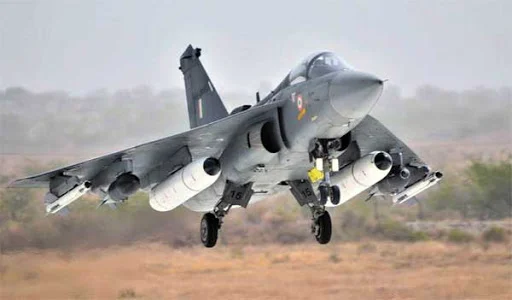
New Delhi. The 13th production Tejas MK-1A aircraft, registered as LA-5045, has successfully completed its maiden flight. This marks an important milestone in sustaining the rollout of India’s indigenous fighter programme, even as the production ecosystem navigates temporary constraints.
The flight was powered by Category-B GE F-404 engines, specially designated as a limited-life contingency measure, ensuring that momentum is not lost while awaiting the contracted full-life engines. The GE F-404 Category-B engines, while restricted in lifespan compared to the standard F404-IN20 variant, provide sufficient thrust and performance levels to enable initial testing, validation, and sortie generation.

Their use reflects a pragmatic approach by Hindustan Aeronautics Limited (HAL) to bridge the gap created by supply-chain lags from GE. Without this measure, the production line could have been stalled, creating cascading delays for delivery targets committed to the Indian Air Force (IAF). The contracted F404-IN20 engines, which are of full-life specification, are expected to replace these interim engines once deliveries from GE stabilise.
These engines form the baseline power-plant for the Tejas MK-1A fleet, optimised for long-term service operations, improved reliability, and extended cycles before overhaul. Until then, the limited-life units will allow continued progression in airframe production, flight validation, and initial handovers. This strategy serves a dual purpose: it prevents disruption to HAL’s Tejas MK-1A manufacturing line and sustains critical operational timelines for the IAF.
Importantly, it ensures that delivery schedules, though tightly dependent on engine availability, are not completely halted. It also enables pilots, flight-test teams, and ground crews to continue working with the aircraft, honing familiarity with the upgraded systems aboard the MK-1A variant, even before the full-life engines are commissioned.
The decision underscores the challenges arising in large-scale military aerospace programs, where global supply chains and international contractors impact delivery schedules.

By incorporating limited-life engines into service temporarily, HAL has created a flexible buffer that secures continuity and reinforces confidence both within the IAF and across India’s aerospace sector. This development illustrates the programme’s growing maturity in finding practical solutions to external constraints, ensuring Tejas MK-1A continues to advance toward its operational integration goals.

